


Pancreatitis is a disease in which the pancreas becomes inflamed.It plays a big role in the digestive system - it regulates energy metabolism, synthesizes digestive juices, and is responsible for the breakdown of carbohydrates.
Enzymes enter first the stomach and then the duodenum, where they begin to activate.If the pancreas is inflamed, enzymes begin to "work" at an early stage - that is, before secretion.Damage appears - the gland begins to digest itself, which causes the death of some pancreatic cells.
Causes of pancreatitis may be:
- Infectious diseases not related to the digestive system - for example, seasonal acute respiratory viral infections;
- diseases of the gastrointestinal tract;
- poor nutrition;
- pressure;
- Alcohol abuse.
Pancreatitis can develop in several forms - acute, reactive and chronic.In acute cases, the pancreas can become inflamed completely or in part;Reactivity develops against the background of diseases of the digestive system - peptic ulcer of the stomach and duodenum, gall bladder or liver.
The chronic form can be in remission for a long time, and most often the disease progresses slowly.In most cases, inflammation occurs again when the diet is interrupted.
The nature of nutrition in pancreatic pancreatitis plays a big role - it is impossible to prevent aggravation without adhering to a special diet.What type of diet is this, and what principles are used to create a menu for pancreatitis?
Nutritional principles for pancreatic inflammation
The basic principle for creating a diet that normalizes the function of the pancreas is to minimize the load on the digestive organs.
During exacerbations, doctors give the following recommendations to adults: "Hunger, cool and rest."If the patient is in the hospital and pancreatitis is in an acute stage, then he is advised to refuse food for 2-3 days, and useful substances - salt and liquid - enter the body by drops.If you fast at home, it is impossible to ensure a normal balance of water and electrolytes.You need and can drink, but only in small portions.
Even adults need to replenish their nutrient reserves.Specially designed diets come to the rescue.The most "tested" is Table No.5.
The principle of this diet:
- Create the most gentle conditions for the stomach and intestines - using mechanical and chemical unloading;
- eliminate pancreatic dysfunction;
- preventing negative changes in liver tissue - fatty infiltration;
- Reduce the excitement of the gallbladder.
The diet should be followed not only during the treatment of the disease, but also for another year after bringing it into remission.
The main properties of the diet in the treatment of pancreatitis:
- In the daily menu, you should limit the number of products that contain substances that have an extractive effect - stimulating the production of pancreatic enzymes:
- refractory fat;
- purines;
- essential oils;
- cholesterol;
- coarse fiber;
- glucose.
- The nature of the diet - food with a high protein content, reducing the amount of carbohydrates and fats.
- Cooking technology - boiling, steaming, baking in foil, stewing.
- Food is fractional - up to 6 times a day, in small portions.You need to get up from the table with a little lack of malnutrition, so as not to burden the pancreas.
- For the first time after suppression, you can eat only pure food.
- You have to give up temporary seasonings, including salt;
- You can not eat hot or cold food;The dish should be heated to body temperature - 36 ° C.
Drinking regime is limited.You can drink as much as you want only when the urge to vomit has subsided completely.
Do not be afraid of dietary restrictions on the first day after an attack - fasting during treatment is only beneficial.
Diet menu for pancreatitis
When compiling the menu for several days during the suppression of pancreatitis, you need to immediately take into account its characteristics - the product must be ground.For example, if there is meat - then soufflé or meatballs, potatoes - mashed potatoes, and so on ...
The menu consists of the following products - their sample list:
- Baby Food - You can use both packaged in jars and powder, which is then diluted with liquid;
- puree - potatoes, cauliflower or white cabbage;
- Pure cottage cheese.
The proportion of nutrients in the daily menu - fat - 50-70 g, protein - 130-150 g, carbohydrates - 300-320 g.
About 2-4 days after the exacerbation, nausea disappears, and it is necessary to restore the amount of fluid in the body.You need to drink about 1.5 liters of water every day, in small sips, a glass every 6 hours.Heavier dishes are introduced into the diet gradually, after the pain is eliminated, one item for each meal.
From this time - approximately on the 4th day - the menu includes the following dishes and products:
- Kefir-only low fat;
- chicken breast soup;
- egg white omelet;
- juice from non-acidic berries, diluted half with water;
- decoction of rosehips;
- up to about 30 g of honey per day;
- dry fried bread;
- flawless crackers or cookies;
- Boiled pasta - You can not use pasta or curls, preference should be given to small noodles;
- Porridge is swept through a strainer;For pancreatitis, you can cook it from buckwheat or oats (some nutritionists allow you to eat semolina, but it must be fully cooked so that it does not swell in the stomach).
You can eat the following foods:
- Lean Meat - Chicken Breast, Beef, Rabbit;
- Fish - boiled, only meat can be used;fish soup and other soups made with fish soup should not be eaten;
- Fruits - baked or mixed;
- Meat soup - secondary;
- Pure vegetables - broccoli, cauliflower, pumpkin.
The nature of nutrition during pancreatitis depends on the general condition of the patient.
How does eating pattern change with pancreatitis?
An approximate diet menu in the first days after the suppression of chronic pancreatitis looks approximately as follows:
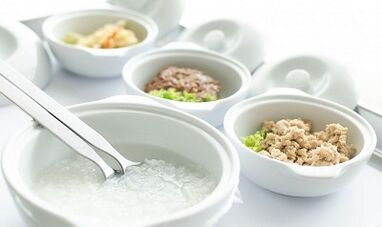
1 day:
- Breakfast - Half a portion of slimy oatmeal soup and half a glass of mineral water that remains;
- Snack - Bake apples without skin and sugar;
- Lunch - mashed potatoes - also half a portion - with milk, without any seasoning;
- Afternoon Snack - Jelly and Bread Flour;
- Dinner - buckwheat porridge with weak tea, white milk;
- Go to bed - a little milk diluted with water.
Day 2:
- breakfast - steamed protein omelet, chamomile decoction;
- snacks - grilled pears;
- Lunch - pearl barley soup, ground, in water, crackers with compost;
- Afternoon Snack - Soufflé Mamm;
- Dinner - Semolina porridge, dried fruits, weak tea;
- Go to bed - half a glass of rosehip decoction.
Next, you can relax the diet a little - if things have returned to normal:
- Breakfast - Oatmeal with dried fruits, preferably with raisins, decoction of rose hips;
- snacks - raw bananas;
- Lunch - Steamed fish with carrots, dried fruit compote;
- Afternoon snack - cottage cheese seasoned with honey;
- Dinner - Milk rice porridge with weak tea;
- Go to bed - half a glass of diluted milk.
Diet for chronic pancreatitis, when things have returned to normal, may look like this - an approximate version of the daily menu:
- Breakfast - vegetables, a piece of meat soufflé, juice diluted with water, weak tea;
- Snack - protein omelette, pieces of steamed chicken breast, a piece of dry bread, kefir;
- Lunch - small noodles in chicken breast soup, boiled vegetables with a piece of steamed fish, bread, dried fruit compote;
- Afternoon snack - crackers with sweet fruit jelly, maybe a little honey;
- Dinner - Steamed Beatballs, rice porridge (or mashed potatoes), boiled vegetables, tea.
If you want to eat before bed, you can eat crackers, sweet fruit, or drink a glass of kefir.
A well-designed menu for the treatment of pancreatitis will help quickly bring the disease into remission.The diet should be followed for a year after the last hate.